Wednesday, 7 October 2009

The "demise of the Dollar" - what it's really about

I posted yesterday about this buzz doing the rounds. I didn't know at the time, but it was Chinese whispers (pun intended) started by Robert Fisk. Enough said.

But that doesn't mean that some of the facts reported could be correct and most probably are. Various oil exporting countries like Iran, Venezuela and developing economies such as Russia and China have almost certainly been thinking about the Dollar for some time. However, not for the reason and economic ramifications that the widespread reports all declare.

I dealt with the issue of the ramification of changing commodity pricing to a different numeraire. Here I will discuss what is the more likely reason behind the supposed deliberations about the role of the Dollar in international markets.

The background to this is exchange rate regimes. Every geographical region - not necessarily defined by sovereign national boundaries but usually so - has over time developed a currency to aid in the exchange of goods and services, the accounting of prices and values and as a way to store value. Those are the three primary function of money:
  • a unit of account
  • a medium of exchange
  • a store of value

These work fine within the regions in which they operate, but hit a road block when one currency region wants to exchange goods or services with another. Hence we need some exchange rate that will price one currency relative to another. This can be set by decree against some durable globally traded item (fixed to gold for example), or against the currency of another region or a basket of such currencies (fixed against the US Dollar for example), or left for the market to price it freely (a "floating" exchange rate). Note that there are all sorts of varieties of fixed rates with names likes "pegs", "crawling pegs", "currency boards" and others, but they are variations of a theme only.

Some floaters include the Australian Dollar, Sterling, Euro, the US Dollar. Some fixed rates include China, Iran, Venezuela, Russia, Saudi Arabia. Are you starting to see the pattern here? Well spotted. Those countries named as the ones colluding to bring the demise of the Dollar are those that fix their exchange rates to the Dollar. And this is what this story is really about.

This story is about the fact that these countries have tied their local currencies to the US Dollar, which means that they have effectively set the price of everything they produce (their income and output) to the price price of everything produced in the US, set in US Dollar prices. So if the US goes through an inflationary bubble and the price of things in US Dollars goes up, pressure will build in the country for prices to do the same thing, bringing in the first instance pressure on output (excess demand) and then inflation. That might seem confusing, but the simple point is that with a fixed exchange rate you will import inflation (or deflation) from the currency to which you are tied.

So it is with some of these countries. China in particular has been struggling with prices in Reminbi that have become out of kilter with the US. That means lots of demand for Chinese goods to be exported to the US. Current account surplus for China, deficit for the US. This brings pressure on Chinese productive potential, the economy is at full capacity and creates shortages and pressure for an increase in the price of these Chinese goods.

What is going on in the background is that this flow of demand for Chinese goods and services is creating a big demand for Chinese Reminbi in exchange for US Dollars at the fixed exchange rate. The Chinese government has agreed to give a fixed amount of Reminbi for each US Dollar and people are flocking to them in droves.

The Chinese authorities have two options.

  1. They keep selling the Reminbi to all comers at the fixed exchange rate. As they do this they accumulate more and more US Dollars, which they need to keep in the form of currency, deposits, bonds etc. This will mean there are more and more Remminbi out in the world looking for a home. That leads to Chinese prices rising - inflation. They try to sell some of the Reminbi for other currencies, but the Dollars are coming in thick and fast and it is a difficult task. Witness the recent Chinese spending spree around the world buying up all manner of foreign assets and interest. This is them trying to unload all these US Dollars. And more are coming in every day.
  2. The alternative is they "revalue" the exchange rate. Each Reminbi will now cost more Dollars in exchange. This chokes off the flow as it has increased the price of Chinese output relative to US output. It also relieves the Chinese economy of the inflationary pressures it was under. They might alternatively just let the currency float and allow the market to push the exchange rate where it will, most likely up in the first instance.

And this is what this story is all about. China in particular, but increasingly many oil producing nations since oil oil prices increased from the lows experienced over the entire 1990s, are following track #1. It is unsustainable as a policy, so they are being forced to consider #2. But there is a political problem with this. Having the exchange rate where it is, undervalued, is not healthy; the Chinese economy for instance is eroding under the inflationary pressures being put upon it the excessive growth that is occurring forcing much investment and expenditure that it might likely regret in years to come (the over-hyped expansion of a small number of urban areas for example). However, the Chinese government (and people to be honest) get a nationalistic pride out of a booming economy that is buying up foreign assets. That is not a criticism of the Chinese people, it is a common human trait. Anyone living in Ireland over the last 10 years will recognise instantly the swelling chests that come with an inflationary boom at home and the ability to stride foreign property markets like kings.

It is a familiar choice. Sensible economic policy, or populist sentiment and beliefs. The latter usually wins in the short term until the proverbial inevitably hits the fan. These countries have been dialling up the speed setting on their fans for a few years now and the projectiles are being stockpiled.

So Robert Fisk might have simply stumbled on the latest discussions about this problem, or this might be a straw in the wind indicating that the time of inevitable revaluation (or even currency float) for these countries is on the way.

That is a big story and an investment opportunity if you can find some cheap way to access it. Go long these mainly developing and OPEC currencies that are under pressure to revalue and short the US Dollar (the second part not necessary if you are US based already).

Tuesday, 6 October 2009

Trading oil in Dollars - who cares...

This story, sometimes appearing in different guises, always gets tongues wagging. The end of the Dollar, the decline of the US. This is BIG news.

No it isn't.

When we want buy something from someone else we need some way to put a price on it. We could say, for example "this car will cost you 50 goats". No reason why we couldn't. The most astute readers will spot some potential problems with such an arrangement; for those buyers who don't own a herd of goats it will be difficult to properly assess exactly how much of your wealth such a purchase will require. How much other stuff, like housing, food, holidays etc. today and in the future will you have to forgo in order to buy this new car?

Follow this up with a couple of questions. Does the simple act of stating the price of the car in goats mean that:

  1. The seller will takes goats and nothing else in payment?
  2. If you don't currently have any goats you won't be able to buy the car, or it might cost you more than if you did have 50 of the critters munching on your front lawn?
  3. The seller is strictly demanding goats in payment (#1) so that they can be added to the ever growing flock in the paddock around the back of the car dealership?

Are we going to get any arguments if I suggest the answers to those questions are:

  1. No,
  2. No and
  3. No?

No.

So what's the fuss about oil (or any commodity for that matter) and Dollars, or Yen, or Euros? We price stuff using some historical convention because it is convenient and communicates a lot of information to the largest number of people. Trading a global commodity sold and bought by everyone around the world is far easier when we talk the same financial language and the US Dollar has been the lingua franca of the industrial age. I can immediately compare the price of oil being sold out of Venezuela with the price of oil being sold out of Kuwait, make any adjustments I need to for differences in composition or quality and transport and know where the best deal is. That is why we use a single currency as a numeraire - which is nothing more than an accepted unit of measure. Sure, goats might make a better numeraire for a Tibetan goatherd, but the world has just naturally come to use Dollars.

But of course I am missing the point aren't I. There will be no need for Dollars any more. People won't want them. Really? Did you think about the questions I posed earlier? Saudis, Venezuelans, Iranians don't sit around thinking "damn, what can I do with all these Dollars I am getting?". They either buy US Dollar assets with them (anything from US government bonds, to real estate or equities or simply cash stuffed under the Persian rug), or they sell them to someone else so they can buy Euro government bonds, Chinese real estate or whatever.

Take the buy side. People aren't sitting on piles of US Dollars simply to buy oil. They trade what ever currency they hold to buy US Dollars (assuming that settlement is in fact in Dollars and not some other currency).

But what about currency risk you ask? If that is of concern, you hedge the currency. Changing the numeraire won't alter the economic implications of exchange rate movements. A 20% appreciation of the US Dollar (with oil price in Dollars) will bring the same affects as a 20% depreciation in the Euro (with oil priced in Euros). In both cases oil will become more expensive for some, in this example Eurozone buyers, relative to others, US buyers.

So, any change to a new numeraire for oil will not bring any earth shattering implications for the global economy. Nor will it happen at the whim of a group of people who think it matters and will try and enforce such a shift - those efforts will fail if buyers and sellers don't find it convenient. It won't be some catalyst to a dumping of US Dollar assets - this would have been done already if people didn't like US Dollar assets.

What it might do is:

  • Reduce the trade in US Dollar foreign exchange markets a little. But hardly to the extent that it would have any implications for spreads or liquidity
  • Reduce the seinorage that the US enjoys. This is the interest free loan that the US gets when someone holds some of their currency. This isn't a lot in the scheme of things at the moment and for reasons discussed above, changing the numeraire for oil trading is unlikely to dramatically reduce foreign holdings of US currency.

No. This story is just another round of penis comparison geopolitics. I fully expect that one day the Reminbi is very likely to become the global financial and trade numeraire. Nobody will need to legislate it, it will just happen over time. It will make nobody worse off and nobody better off, but simply change the language in which we talk numbers.

UPDATE: Just goes to show how poorly this blog is read. I have amended the incorrect reference to "Yen".

Monday, 5 October 2009

Talking taxes

Income taxes that is.

Deep recessions following boomy booms almost invariable entail nice big fat public deficits. What usually happens has now happened again; our elected public representatives fool themselves into thinking that the tax revenue windfall associated with a monetary bubble are genuine, when in fact they are transient. When economies correct, the fact that politic ans have been spending far beyond the country's (i.e. tax payers') means is revealed and large deficits appear.

The economic concept is that governments may have been running significant cyclically adjusted deficits. Simply, the public balance (tax less spending) adjusted for economic output above (or below) its long run potential may be quite different to headline numbers.

And when we get deficits like this, tax rates are in the firing line. The UK Chancellor has announced a nice juicy new 50% top marginal tax rate (up from 40%). Ireland is incurring a raft of new taxes levied on income. The US is threatened with similar. The affect in Ireland is quite phenomenal, talking from personal experience. What, I would argues, is an extremely unbalanced income tax regime, raising the massive majority of incomes tax from a narrow band of earners, is becoming almost unbearable.

Consequently, I thought I might look at how Ireland's income tax system sits relative to others.

What follows is a brief look at some of the marginal and effective average tax rates that apply to Ireland and compared with the US and UK. This is only one abbreviated way to look at the data, given the fact that their is an almost infinite number of ways to cut things, given that most regimes treat different people in different ways for tax purposes (married versus single for example). But what follows looks at rates that apply to single earners and ignore any manner of tax concession that might apply. I would suggest that the extent to which different classes of tax payers receive significantly different treatment represents a failing on the part of a tax system.

Here is exhibit #1. Marginal rates that apply, including national insurance contributions in Ireland and the UK. Note for the US, these are Federal rates only, so they are good for Texas for example.


The X axis is local currency units, £, $ and €. Ireland starts with low marginal rates kicking in at relatively high minimum earnings levels. The US has low rates throughout, but more grades. The UK has higher rates kicking in lower down the earning scale. Both the UK and Ireland have much higher top marginal rates that take affect much earlier than in the US.

Also note some of the quirks. Irish (and UK) tax rates jump to very high levels very quickly. 50% of marginal income going in tax is a lot. Beyond that the government is effectively saying there is some income over which you don't have the right to keep even half. Note the spike in the UK marginal rate, which is an artifact of National Insurance rates hitting a ceiling.

While these lines appear on the same chart, they are not of much use for cross country comparison. We need some way to compare different income levels across countries. The way I propose to do that is to adjust the scale to a common currency (Euros), using a Purchasing Power Parity rate of exchange. I have used consumer expenditure PPPs and I lift these from the OECD and the most recent data is for 2007. If we do that we can compare $ and £ to Euros on the basis that we have tried to adjust the numeraire to a basis of common purchasing power.

If we do that the chart looks like this:


I have added some vertical lines to denote where Irish median (and 150% and 200%) earnings fall.

What you first notice is the shift in the lines. The top rate of tax in Ireland clearly begins to bite at a much lower level of income than in the UK. In fact it kicks in at the median earnings - so by definition half the income earners in the country should pay some tax at this rate of 50%. Let's now compute what this would imply for average rates of tax paid across the earnings scale:


Now this is the money shot, so to speak. This is the average rate of tax that would be paid under the marginal rates shown above. Here are some of the striking characterstics of the Irish structure, especially compared with the US and UK:

  • There is no tax paid until someone earns at least 50% of median earnings. Not even a token 5%, that might encourage some sense of social contribution.
  • By the time someone earns the median wage (nearly €38,000 per annum), they will pay less than 15% in tax. Note that this is before any types of legal tax avoidance measures that are available.
  • Beyond the median, income tax burdens rise at a dramatic rate. at 150% of the median you will pay around 25% of you earnings in tax.
  • The pace of increase slows only marginally beyond that and at a mere 200% of median earning it has increased to 33% of earnings in tax. That means someone earning twice the median earnings (€75,000) pays nearly 5 times as much tax as someone on median earnings.

Now personally, I would favour something more in the style of the US. It is progressive, in that the higher your earnings, the higher the proportion you pay in tax. But it is not massively progressive as evident in Ireland.

Secondly, A larger proportion of earners pay something and something material relative to everyone else. Low to median earners might pay 5-10% of their income in tax, compared with 20-25% for those on 2 or 3 times median.

One thing is clear from this. Ireland is no "low tax" country.

Thursday, 1 October 2009

Tax Commission report – congestion charges

Economists just love congestion charging. Academic economists I mean. It pushes all the hot buttons for them. A widely accepted source of “market failure” (negative externalities), loads of primary data collection and analysis, scope to play with prices and estimate demand curves in a real life situation. It is one of the very few areas where economists can play at being real scientists, with experiments and stuff, like.

I tend not to like them so much. Not in theory, that is pretty sound in an abstract way. But in the practice. It turns out if you really dig into this, congestion charging in most standard real world conditions is wasteful, produces an inefficient allocation of resources, opens up potential inequities (in particular regressive ones that punish lower income groups) and creates a dead loss to society in terms of welfare (I mean like making everyone pay up some money only to put it in a pile and burn it).

Let’s start with the theory. We tend to get more efficient allocation of scarce resources when there are clear and transparent prices that incorporate all costs of production. That way, people only do something if the price is less than or equal to the utility (pleasure, sustenance etc.) they derive from it. It means resources don’t get wasted where they aren’t really needed or wanted.

The concept of “externalities” in economics was identified some time ago. These externalities can be positive or negative if they impose a benefit or a cost on someone else. A lighthouse has positive externalities, while a cigarette being smoked in a confined place has negative externalities (cough, cough). The issue at hand here is negative externalities. The concept is that in the act of doing something, or consuming something I impose a cost on others. The theoretical economic framework for this is that the marginal social cost exceeds the marginal price I pay. Consider this. I drive to work at 8am and base my decision on how much petrol and wear and tear etc. on my car will cost me for the journey. I do not consider in my decision the inconvenience that my presence on the road might cause others (the congestion effect). So I base my decision on a price, but the price I am paying is less than the marginal cost. That means I am doing too much of it. Well, not me specifically, but those people for whom the price is only just worth paying. If you made them pay more, they would not drive and hence reduce the congestion affect that have on others.

The problem with the use of this type of analysis in support of a congestion charge is that it ignores a fundamental characteristic of congestion costs; they are perfectly reciprocal. What do I mean by that? I mean any costs you impose on others bounce back in equal measure to you from them. Just think about it. If my decision to drive to work at 8am has the affect of increasing the journey time of every other person on the road at that time (say 10,000 of them) by 0.1 seconds. So the total cost I impose on others is 10,000 times 0.1 seconds = 17 minutes of total lost time. But everyone else is equally guilty and each of my commuting buddies impose the same cost of 0.1 seconds of increased journey time on me. So I suffer a 10,000x0.1 = 17 minutes extra commuting time.

So, although I am indeed imposing an external cost on others, they are imposing an identical cost on me. Perfect symmetry and most importantly perfect information for me to make my decision.

When deciding whether to drive to work at 8am in the morning I am not expecting a clear road. I know I am going to suffer congestion costs. And I have an excellent idea of precisely how much they will be. And I don’t think that makes me particularly clever, everyone else will have the same information. So if I drive I am doing so on the basis that it will cost me an extra 17 minutes in travel time, which is exactly the same as the external costs I will impose.

All this means that there is no place for policy intervention. I am making an efficient decision that reflects all costs, including the external ones. To place a congestion charge on my journey would create an inefficiency, not address one.
A nice analogy is a “smokers’ room”. Smoking in an office would create external costs that fall on others. But if you have a smokers’ room where people can go to smoke you will instantly internalise the externality in the same way that road congestion does. Everybody in the room is there of their own volition, knowing that they will have to put up with the inconvenience of other people’s smoke. The only real issue is who pays for the smokers’ room. As long as the smokers pay for it, maybe on an entry fee basis, everything is efficient and equitable. Road users are similar in this way. The more you drive and the more congestion you sit in, the more tax you pay on the petrol you burn – hence paying for the road system on which you sit.

Instead, with a congestion charge, we layer even more cost to monitor and account and administer the scheme, we prevent people from driving as much as they would like (even after correctly pricing the cost of congestion they impose) and underutilise the roads that we spend a lot of money to build. This creates a dead loss to society.

So congestion charging is typically inefficient and an abominably poor application of economic theory.

But what about equity issues? These are usually brushed under the table a little when it comes to congestion charges. But consider for a moment the range of people you might see sitting in that rush hour traffic jam. They will range from shop assistants and nurses, to bankers and company CEOs. Now think about how they price their time. People in lower paid jobs would typical value money over time (it is an awful expression, but their time is cheap, so to speak). For high flyers, the opposite is true. So if you introduce a congestion charge you are actually setting a price for time, because that is where congestion has its economic affect. And who suffers most? Those who would rather spend an extra 30 minutes getting to work than have to pay €10 in a congestion charge; the lower paid. This makes a congestion charge regressive as it favours those who place a higher value on their time, which is invariably those on higher incomes. Think of the case of Michael O’Leary who went to the expense of buying a taxi licence so he could drive in bus lanes and beat congestion. A hypothetical congestion charge of €50 per day would delight Michael O'Leary and increase his welfare, but would be detrimental to someone struggling by on a below average wage.

So all in all, congestion charges are a bad idea, creating economic inefficiency, regressive welfare affects and a financial and social dead loss.

Wednesday, 30 September 2009

RIP quality journalism

The Gruaniad is a newspaper that seems to pride itself on notoriously poor standards of fact finding and editorship, but I have just been bowled over by a superlative piece of garbage that went up on their web site this week. No surprise that it appears in their "environment" section and no further surprise that it is yet another lame piece of climate change alarmism.

Have a look at the article and then do as much fact checking that you can in, say, nine tenths of a second.


Adelaide latest victim of global water shortages

Australia's fifth-largest city could be reliant on bottled water as early as next week as overuse and drought stretch the Murray river to its limit

http://www.guardian.co.uk/environment/2009/sep/28/adelaide-water-drought


Pretty self explanatory really, but also seriously alarming. Adelaide (the fifth largest city in Australia) must surely be in a state of emergency given such an imminent event. Can you imagine the logistics involved in the supply of a city with bottled water, the restrictions one would need to place on any water use at all in order to prevent all manner of disasters and even death?

Google must be running hot with links to local press warning the populace of the danger they face and the things they need to do....


Oh.

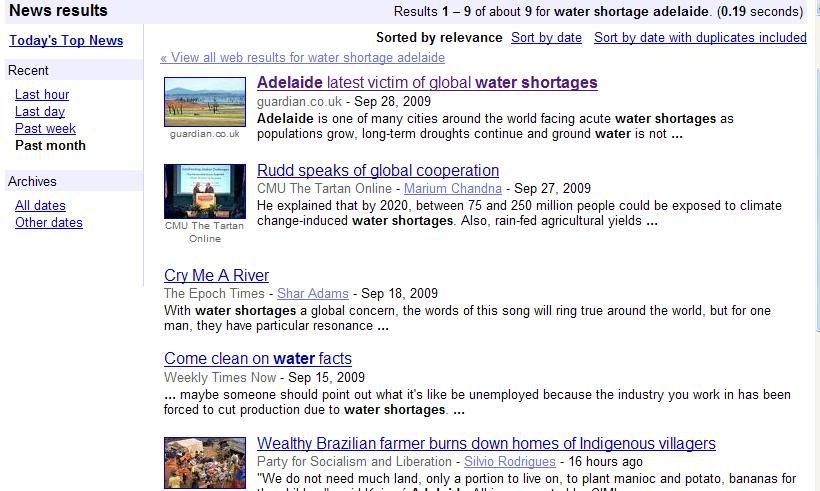
9 potential news articles. Only one referring to this disaster, from the Gruaniad itself.

No bother, this means nothing. The Gruaniad journalists are quick off the mark. They get the scoops weeks before other inferior news hounds. A quick look at primary sources will reveal the astonishing speed with which these paragons of the news media have pounced on cold hard verifiable FACTS:


Oh.

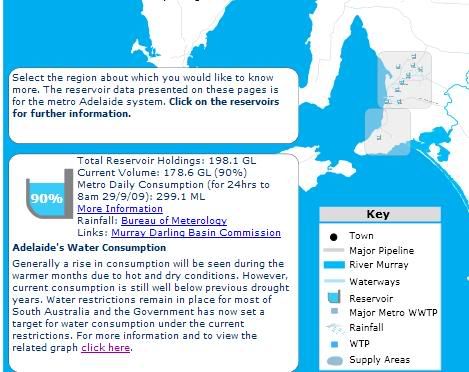
Adelaide reservoirs 90% full. Maybe they are filling the bottles at the reservoirs for distribution to this thirsty city.

Never mind, the South Australian Water authority are consummate professionals. They will be on the case and will be ensuring that water is being used for the most essential purposes only. Sure enough, they have put everyone on LEVEL 3 ENHANCED WATER RESTRICTIONS!!! This is definitely serious.


Dripper systems and hand-held hoses fitted with a trigger nozzle can be used for a maximum of 3 hours a week
What? Don't these dolts realise that there will be NO WATER NEXT WEEK? And they are still letting people waste it on their gardens!?! They are rushing headlong into this disaster.

I await the upcoming Gruaniad reports of this unfolding crisis in the coming days with great anticipation.

UPDATE 14 OCTOBER:
I received this disturbing e-mail today [I do hope this poor soul survives]:

Still waiting on the bottled water to arrive. Can't hold out much
longer. So... thirsty...


Thursday, 24 September 2009

"Jobs"

Language is a powerful influence on the way we think. Take the word "jobs". An innocuous word in itself, used in many and varied context. Most people would be familiar with its use in forms such as:
"protecting jobs"
"creating jobs"
"exporting jobs"
"this will cost jobs"
"this government policy will cost jobs"
or my favourite at the moment:

"turning our back on Europe will cost jobs"
All leave a visual impression of a tangible object, like a book or a cup. Things that can indeed be "protected", "created" or moved from one place to another or even lost forever down the back of the sofa with all that loose change and lolly wrappers. The natural extension of such thinking is to believe implicitly that these things are fixed in number, that if I have it you can't. In economics speak, we would say rival in use, or consumption.

On those general impressions, reinforced by that language, the electorate in every country I can imagine believe they are involved in a global economic tug of war, fighting for these "jobs". This isn't good. For one, it provides the fuel for protectionist behaviour that adversely affects everyone's welfare.

The problem is, like many widely held beliefs about economics, this impression of "jobs" is wrong. It simply is not true that the relocation of output from one country to another (for example Dell moving from Ireland to Poland) will leave a hole created by a theft, or exportation, of "jobs". Nor is it true that some form of government policy (read public spending) is needed to fill such an imaginary hole.
And why is that the case? The reason is because there are no "jobs" per se, but an amount of labour that is needed to produce a given quantity of goods and services for the available technology and capital stock. And the amount of labour you use, relative to the amount of capital used (the level of known technology is simply a given at any point in time) will be determined by how much labour costs compared to capital.

If your production process requires you to open cans and labour is very expensive, you will buy an automated electric can opener and employ one person to operate it. If labour is cheap, you will buy 6 manual can openers and employ 6 people to operate them. The key is in the price of labour, or wages. "Jobs" will be there so long as wages are flexible and an economy is allowed to move from one state to another. They won't be lost, stolen, created, exported or anything else.

You can see the crux of the issue here though. It is all about the flexibility of wages; by which I mean the level of wages relative to everything else, including stuff in other countries. This is the only way that a shock to the economy, or any policy will "cost jobs" - if we refuse to allow wages to adjust.

So the only way that an economy is likely to be left with a shortage of "jobs" (i.e. persistent excessive unemployment) is if the price of labour doesn't adjust, or if some obstacle to movement of labour from one region to another, or from one industry or skill set to another is impeded. Note here that large scale government "training ", like the Irish FAS can in fact be such as impediment - but that is for another post.

What may happen is that wages might need to fall to restore full employment, which could imply a lower level of income on average. But there is no point in fighting that. It is a superior outcome to what would be a lower level of income and a larger number of unemployed people who are without employment for longer periods of time.

Here are the important implications of this that everyone should bear in mind:

A government does not, can not, "create jobs". Reject outright any rhetoric based on such a lie, it is usually a political ploy from the CEOs of the most dominant and powerful industry in the world, the political one.

Buying goods or services from abroad does not "cost jobs". Nor does buying domestic goods "support jobs".

Wednesday, 23 September 2009

When myth meets economics

Economists get a bad rap a lot of the time. And, on occasions it is well merited. But more often than is commonly imagined fault lies in alarming widespread and firmly held beliefs that support damaging policies by government.

Trade is a goldmine of examples. Take the experience of the Great Depression. One feature of the this tragic period in modern history was a descent into protectionism and an unwillingness to trade (i.e. import) goods and services from other countries. The graphic below is modestly famous, appearing in an Economist article on the Hawley-Smoot Tariff, that was arguably the catalyst to a general retreat into economic isolation around the world. Some think it ugly, or contrived, but I find the chart illustrates the annual contraction in the volume of trade. Each circle encompasses an amount of trade which gets smaller and smaller. Hawley-Smoot brought into effect more than 800 different tariff increases. Naturally, other countries followed suit. The result was less trade.

While supporters of these tariffs might try to maintain that the affect was as intended (keeping out foreign imports in favour of domestic production), they might baulk slightly when one explains that the chart below shows the decline in total world exports; most anti trade proponents tend to be of a mercantilist flavour and believe, no insist, that imports are bad while exports are good. Everyone was exporting less. This is of course a trick, every import is in fact an export, but the point is valid. There are no exports without imports. A type of Yang and Yin if you like.

What you don't see when you look at this chart is the loss in income and welfare around the world as we stopped trading with another.


That is an interesting trip down memory lane, but what relevance is it for today. Well there is more than one point to make.
  • Firstly, economists fight a never ending battle against the enemies of trade. Strangely, over time, this continues to be the overwhelming proportion of the population.
  • Secondly, trade protectionism is a classic knee-jerk response that comes at time of recession. It is intuitive, but badly flawed, to believe that you can "save jobs" by buying locally produced goods or services only or preferably.
  • Third, we are facing a rising specific threat at the moment. This is partly related to the point in the economic cycle in which we find ourselves, with unemployment high and rising nearly everywhere. But we also have to deal with Climate Change catastrophists who are lobbying and legislating for taxes on anything with a carbon-based energy component in it. Unfortunately, that is everything, because the use of energy has been the bed rock of our improving welfare ever since man lit his first fire and dramatically reduced mortality from hypothermia, nocturnal predictors and bacterial infection from eating raw meat. And given our present technology there is no cost comparable alternative.

One of the darrrrlings of the Climate Change Catastrophe industry is the Waxman-Markey Bill in the US which has plans to place an explicit or implicit tax on fossil fuel use. This would increase the cost of energy as a way of reducing its use. However, such a law introduced in the US would simply mean that production would move overseas. So the Bill has provision for tariffs to be applied to imports of goods from other countries. Bad news.

It doesn't end there, Nicolas Sarkozy is a fervent admirer of such an idea (what, an anti trade Frenchman???) as it could also help square the political circle for the EU thinking of doing something similar.

And people lap it up, keeping out those nasty imports.

I live in dread.