Showing posts with label Odds bods. Show all posts

Monday, 8 November 2010

Let them eat cheese

If proof was needed that we have truly descended into the rabbit's hole, the Irish Government has helpfully announced their program to give away cheese to the masses. Of course, when I say masses I mean that elusive body of the population variously labelled as "the most vulnerable", "the poor", "those in need". In other words, that politically useful rhetorical devise; "the third person".

Once we all stop laughing and crying in equal measure, let's just turn to some economics to make some interesting observations and some random predictions.


  • The cost of this scheme in terms of packaging and distribution, verifying that the recipients as indeed "the most vulnerable" etc. most likely rivals the costs of handing everyone who qualifies a €20 bonus in the welfare payment.

If the reports are to be believed, vis:

The cheese is available in 12 x 1kg boxes from stores in Clondalkin, Portlaoise, Kilmacthomas Waterford, Cobh and Togher Co Cork from November 15th with a “minimum of one box per collection”.


(a minimum of 12kg of cheese each!!) we will have a nice little arbitrage opportunity opening up. Prepare to see markets do their stuff. So:

  • This could mean cheap cheese for everyone, as enough clever clogs see the opportunity to take a few boxes of their free cheese and sell it on. There may be attempts to restrict the sale of this cheese, but that is likely to futile as either nothing will be illegal about it, or a black market will simply develop.

And when this secondary, or black market for cheese develops, the demand for cheese via regular outlets, like supermarkets will fall. In order to prevent wastage, the price is likely to be discounted, potentially below cost in order to clear purchased stock.

Or, an alternative scenario:

  • Clever supermarkets recognising this potential cheese glut curtail significantly their cheese purchases over the next month. That might lead to a shortage of cheese in supermarkets. Riots in the dairy aisle shopping mums and toddlers battle it out for the last 500 gram block of red cheddar.

And of course the medium term consequences:

  • Cholesterol levels sour and heart disease takes off. The strain on the national health budget increases and our cheese binge starts to look like a big mistake.

Oh, how much fun it is to live in Ireland today. The comedy rolls on every day.

Wednesday, 13 October 2010

"Equality"? Give me a break

The World Economic Forum is probably the most absurd "economic" organisations in the world. Famed for its ludicrous "competitiveness reports", it also produces other useless and complete harebrained "reports, like the "gender gap index".

The complete absurdity and nonsense of this type of work is apparent in its own methodology.

For example, Ireland demonstrates comparable "inequality" because men have a life expectancy of only 96% of that of women. The longer women live relative to men the more "equal society is apparently. So imagine if we could produce some "gender equality" policies that shifted this 96% figure to 90% or even 50% - hey that would probably generate a boost to the aggregate "equality" ranking.

The same absurdity appears in all the other comparable scores the boost the supposed "gender" equality as women increasingly dominate outcomes for men in education, representation in professional classes etc.

Next look at the male/female birth ratio. As pure statistical indicator, a low female to male birth ratio is in fact a boon to women - as China is now finding out. Women have complete control of the partner selection process. Men are increasingly left into the middle ages at the fringes of society. Perversely, this supposed "inequality" towards women is in fact leaving men not women disadvantaged in Chinese society.

I don't think I will bother with this report.

Monday, 5 July 2010

How regulation kills our quality of life

I enjoy listening to music on the bus on the way to work. So I bought myself a new iPod. A great little piece of technology (except for Apple's anti-competitive business model). I have found out after buying it is is useless for listening to music on the bus because you can't hear over the ambient noise of engine, wind, tyres etc.

I initially thought there might be a fault with it, but to my dismay I found out that those useless drains of the taxpayers' pocket, the European Commissioners and Parliament, decreed regulations that set the maximum volume output for such devices.

What a piece of life diminishing regulation, proposed and decreed by buffoons looking for things to do. iPods have always had a volume limiter you could set so that you didn't inadvertently turn the thing up too loud. But apparently, the people eating the cake are to be directed and told what to do, so a permanent limit needs to be set by the manufacturer.

Thank you, stupid, idiotic, moronic, manipulating, parasitic, tax stealing politician and bureaucratic apparatchik. You have wasted €150 of my money, which I have blown on a device that can't do what I, reasonably, want it to do - let me listen to music on the bus.

The industrialised world is truly killing itself cut by cut.

Thursday, 24 June 2010

A must read

Add this to your reading list. A most insightful and complete lecture from Deepak Lal.

http://www.econ.ucla.edu/workingpapers/wp814.pdf

Monday, 14 June 2010

Economics for crash test dummies

Time for a change of gear from recent posts. Every now and then it is interesting to see where economics has applications in the real world in areas that one wouldn't normally expect to see any relevance. I suppose you could call this a bit of a "Freakanomics" diversion [that was in fact the book I always intended to write - but I don't think Freakanomics will be bettered in this genre].

So, I was watching a car show on television the other day, not Top Gear (which is brilliant). In it there was a segment looking at car impact safety and how it has advanced over the last 10-15 years. The set up was that they crashed a 1990 something Volvo 940 into a 2007 Renault Modus. Now, Volvo have always had the reputation for being safe cars and the 940 is a significantly large car than a Modus - and crucially has a much longer front bonnet (better for providing an energy absorbing crush zone than the stub-nosed Modus).

http://www.youtube.com/watch?v=qBDyeWofcLY

What happened when they threw the cars at one another head on at 40 mph was a near total destruction of the Volvo, with very serious incursion of the impact into the passenger cell of the car. By comparison, the Modus showed virtually no sign of impact from within the cabin. A driver in the Volvo would almost certianly have suffered extremely serious injuries, while one in the smaller Modus may have escaped with light grazing only.

Interesting, huh? But where is the economics?

The economics is here - and it is in the form of an application of both externalities and game theory. To take you through it you need to go back a few decades in car design, to a time when big, strong and rigid was the order of the day.

In the 1960s a safe car was a big and strong car, able to withstand impact and keep the passengers inside within a protected shell.

By the 1970s engineers were working with new materials and technology and thinking shifted to provide for a rigid passenger cell, with softer, energy absorbing crumple zones at the front and rear. That technology existed into the 1990s - and is evident in the Volvo 940 here.

Now we have moved on further, with new technology entering into the industry, designed specifically to make smaller cars (now more popular) safe in high speed impact. That is the Modus, which has a very small crumple zone in the front, and extremely strong front firewall and just as crucially a small and light low mounted front engine.

What the display showed was how effective all those elements worked together on the Modus, but one thing caught my attention. As good as the Modus saftey features were, a large amount of the energy in the crash was absorbed by the Volvo, which all but disintegrated. In effect, the Modus used the Volvo as an additional crumple zone. Had the same test been run with a big heavy and rigid 1960s design car, I doubt the Modus would have fared nearly as well. Not only would there have been less energy absorbed between the two cars, the opposition would have been significantly heavier and we know that energy is equal to mass squared.

And there is the economics. You can design a really safe small car like the Modus, if you know that everyone else will be driving around with a big soft crumple zone on the front of theirs. You can get away with carrying less energy absorption around yourself. That is the externality - you can be safe by demolishing somebody else. Of course, that works only until other drivers recognise that change their cars to something that provides them with more safety in the event of a crash with a Modus - the alternative strategy is to drive a Hummer with a "roo bar" fitted. A Modus wouldn't survive so well as the Hummer would likely use it as a stopping aid.

And there lies the game theory. The safety of your own car in a crash is a function of what someone else drives. You modify your decision based on what the best payoff will be for you given the likely option chosen by others. The next time you run into that Volvo 940 driver in your Modus, it is more likely they will have switched to the aforementioned Hummer.

Tuesday, 20 April 2010

Risk versus Uncertainty - in the skies over Europe

Planes are grounded yet again across Europe as volcanic ash and particulates disperse into the atmosphere out of Iceland. The "risk" to passenger safety is too great, so the authorities issue grounding orders across most of European airspace.

By all accounts the risks associated with flying an airplane into a cloud of volcanic emissions (catastrophic engine failure) are not worth the potential benefit (getting from A to B quickly). Hence, preventing planes from flying into such clouds is an extremely sensible risk mitigation policy. No argument. Then why are we starting to hear grumblings from airlines, complaining that they are being grounded unnecessarily?

Is it because they are just trying to turn a buck and there isn't much demand for a ticket on a plane that can't take off? Definitely.

Is it because airlines, driven by their profit motive, are more cavalier when it comes to risk? Almost certainly not.

So what gives?

It's all about risk versus uncertainty. So it is worth going back to basics to understand why these two animals are related, but different.
  • Risk is the extent to which any particular event may have multiple outcomes.
  • Uncertainty is the extent to which we have incomplete knowledge about the nature, range or relatively likelihood of these multiple outcomes.
For some people that is a "so what" proposition. However, I am pretty certain that for the overwhelming proportion of the population that is a "huh?" proposition. Assuming the former have already moved on, I will expand further for anyone interested in reading more.

Let's proceed by contrasting two examples. Let's first take a coin toss. Say we bet on a coin toss, so our fortunes are inextricably tied to the outcome. The toss exhibits "risk" for us, there are multiple potential outcomes - heads we win, tails we lose. However, there is relatively little "uncertainty" - a decent spinning toss should have a 50% chance of coming up heads and a 50% chance of coming up tails (rounded to exclude the odds of it landing on its edge). We can be pretty certain of those probabilities, if we know who is tossing the coin, how the coin is being tossed, the nature of the coin being tossed - these are all regular, observable (knowable) qualities. This example exhibits a lot of risk for us in our bet (one chance in two that we lose), but relatively little, if any, uncertainty (we are pretty confident that it is at least very close to a 50/50 chance)

Now lets look at flying in a plane. To simplify the infinite number of potential nuanced outcomes; the plane may complete its journey or the plane may crash. So, like the coin example, our next step is to try and quantify the relative likelihood of the potential outcomes (assuming we have correctly identified all relevant potential outcomes). In this situation the airlines and regulators have made decisions and taken actions that are designed to affect the relative likelihood of the outcomes (crash/not crash in our example). The plane has engines for example - always a good start. The pilots are trained professionals - always a bonus I find. There are copious check lists and scheduled maintenance routines. And so on and so forth. Moreover, we have emprical data for millions of commercial flights and only a very small proportion of those have resulted in crashes. So we are left with an estimate of the probabilities of Very Low (crash) versus Very High (not crash).

Where are the numbers, the hard probabilities this time I hear you ask. Well, I can't give them to you. Why? Because I am uncertain of all the various things that could possibly go wrong, be completely unanticipated, or are just so absurd as not to waste time considering them (shot down by an alien spacecraft). Such is uncertainty. In technical-speak, I am unable to specify the probability distribution function. In this example, we have low risk (the odds of crashing are estimated to be extremely low), but we have a lot of uncertainty (is the probability of a crash 0.01% or one hundred times greater at 1% for the specific flight in question? - we can't tell. It may in fact be 50% if someone happened to leave the work experience kid to do the pre flight engine check).

So what are the implications of this and how does this relate to plumes of volcanic ash?

Well, first off, note what is the most important implication of this understanding for risk and uncertainty. We act to mitigate against risk - that is try and prevent the known potential bad outcomes occurring. The more successful we are at doing that, removing risk, the more we are left with uncertainty. People who are scared to get on a plane because they are scared of the "risk", are actually scared of the "uncertainty" - the unknown or unknowable factors that might be at work. And you can't do anything about uncertainties directly - obviously because you don't know about them. And there is the crux:

Uncertainty is just a condition dependent on how much information we have - remember that because I will return to it.

So, on to the ash and trying to understand why airlines seem willing to fly their passengers into ash plumes, while regulators aren't. It isn't profit motive per se, although it must be accepted that the regulator isn't affect by whether the planes fly or not. In this particular instance there is specific cause to believe that a tussle between risk and uncertainty is taking place and one party might be confusing the two concepts.

According to reports, the Europe wide ban on flights is largely the result of the work of the UK Met Office. They model the atmosphere and predict where the volcanic emissions might drift. They come up with a result and recommend that flights be banned in the areas around which their model suggests the ash will be. Very sensible in itself, it is an attempt to assess the risk. However, what this work does not incorporate is physical measurements of where the ash actually is at any time. So, there is also significant uncertainty at work here.

Planes are being grounded because of the risk (the estimated odds), certainly. But, they are also being grounded because of the uncertainty (the not being confident of the estimated odds). Now, this is where things could possibly end. When we make such a decision, the uncertainty needs to be considered in conjunction with the risk and combined they suggest that it is prudent to ground planes.

So the airlines are wrong you might say. Well, not necessarily. What the airlines are validly pointing out is that the uncertainty part reflects our lack of sufficient information, which affects our confidence in assessing the risk. And they go on to point out that there is more information that could be obtained. That information is where is the ash in reality (as opposed to where it is modelled to be), which they suggest can be obtained by making measurements, possibly by flying suitable test flights in certain areas, or using balloon based sensors maybe. The simple analogy is that you don't put on a heavy coat when you leave home simply because you are uncertain about whether it is cold or not - you take whatever practical steps you can to gather a bit more information, like walk outside, so you can remove more of the uncertainty and leave yourself with the risk that it may or may not get cold later.

The airlines are saying that some of the uncertainty, which is part of the reason for the blanket flight ban, is not because we lack sufficient information, but because we aren't even bothering to gather the relevant information. And that is a valid point.

So who is right? Well, both are and neither are. We just don't know. We are dealing with uncertainty, remember? But one thing is certain. If we understand the difference between risk and uncertainty, we can make better decisions. In this case minimise the possibility of a crash, but also minimise the possibility that we are unnecessarily curtailing air transport.

Sunday, 10 January 2010

Playing with fire

One of the consequences of the large current account surpluses being run by developing Asian economies - see related posts here and here - is that these countries have an increasing pile of foreign exchange they need to spend. Add to the fact that some of these countries have, let's say, a tenuous grasp on liberal market economics (let alone western democratic civil liberties) and we get some interesting stories. Like this one:


TWO senior Qantas employees prevented from leaving Vietnam after financial losses on fuel markets have done nothing wrong, Qantas chief executive Alan Joyce said in Sydney yesterday.

Jetstar Pacific chief operating officer Daniela Marsilli and chief financial officer Tristan Freeman were refused permission to leave Vietnam on December 19 and are being investigated over losses linked to a practice known as fuel hedging.


http://www.smh.com.au/travel/travel-news/australian-staff-in-vietnam-did-nothing-wrong-20100109-lzv2.html


As a main board director of a publicly listed company could you place your employees at risk of such behaviour from your supposed co-shareholders or business partners. I for one would feel that I had some responsibility for employees not being treated in such a fashion.


Should boards be factoring in their responsibilities in these areas and potential risks to themselves if nothing else before they get into bed with such unusual capitalist bed fellows?

Wednesday, 30 September 2009

RIP quality journalism

The Gruaniad is a newspaper that seems to pride itself on notoriously poor standards of fact finding and editorship, but I have just been bowled over by a superlative piece of garbage that went up on their web site this week. No surprise that it appears in their "environment" section and no further surprise that it is yet another lame piece of climate change alarmism.

Have a look at the article and then do as much fact checking that you can in, say, nine tenths of a second.


Adelaide latest victim of global water shortages

Australia's fifth-largest city could be reliant on bottled water as early as next week as overuse and drought stretch the Murray river to its limit

http://www.guardian.co.uk/environment/2009/sep/28/adelaide-water-drought


Pretty self explanatory really, but also seriously alarming. Adelaide (the fifth largest city in Australia) must surely be in a state of emergency given such an imminent event. Can you imagine the logistics involved in the supply of a city with bottled water, the restrictions one would need to place on any water use at all in order to prevent all manner of disasters and even death?

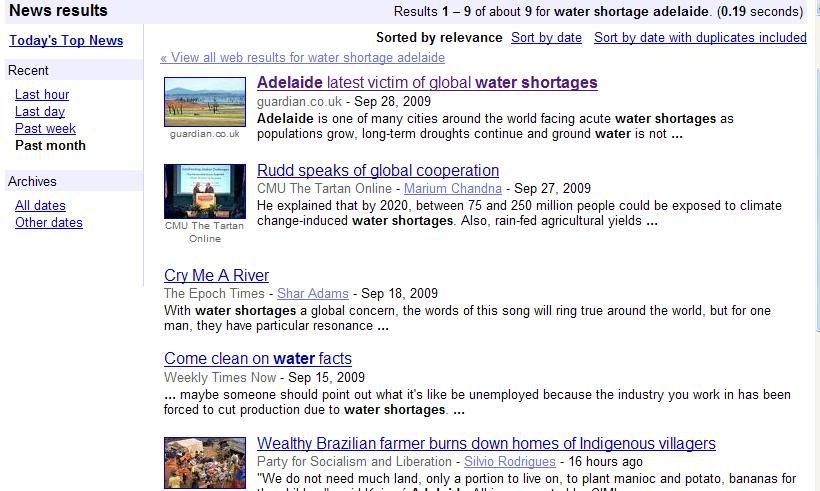
Google must be running hot with links to local press warning the populace of the danger they face and the things they need to do....


Oh.

9 potential news articles. Only one referring to this disaster, from the Gruaniad itself.

No bother, this means nothing. The Gruaniad journalists are quick off the mark. They get the scoops weeks before other inferior news hounds. A quick look at primary sources will reveal the astonishing speed with which these paragons of the news media have pounced on cold hard verifiable FACTS:


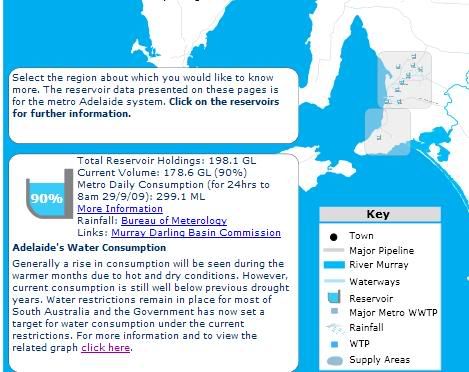
Oh.

Adelaide reservoirs 90% full. Maybe they are filling the bottles at the reservoirs for distribution to this thirsty city.

Never mind, the South Australian Water authority are consummate professionals. They will be on the case and will be ensuring that water is being used for the most essential purposes only. Sure enough, they have put everyone on LEVEL 3 ENHANCED WATER RESTRICTIONS!!! This is definitely serious.


Dripper systems and hand-held hoses fitted with a trigger nozzle can be used for a maximum of 3 hours a week
What? Don't these dolts realise that there will be NO WATER NEXT WEEK? And they are still letting people waste it on their gardens!?! They are rushing headlong into this disaster.

I await the upcoming Gruaniad reports of this unfolding crisis in the coming days with great anticipation.

UPDATE 14 OCTOBER:
I received this disturbing e-mail today [I do hope this poor soul survives]:

Still waiting on the bottled water to arrive. Can't hold out much
longer. So... thirsty...


Tuesday, 22 September 2009

At last a "rock solid, steady" PC application

Is there some way we could convince these people to design a PC operating system?

The Conficker worm

"Conficker has proven to be the gold standard for botnets. It's rock solid,
it's steady
and it has mechanisms built in that have made it impossible for us to actually crack," Joffe said.

Wednesday, 9 September 2009

Life as a consumer

Sometimes it’s hard not to be cynical about business and their approach to their customers. No more so than in the telecoms industry, which in Ireland is a complete basket case. This is supposed to be a deregulated competitive market where the “local loop”, the line that runs to your door, can be leased via any available supplier on request. Theoretically, this opens up competition in stuff like broadband. Unfortunately this is more in theory than practice.

Take my current broadband experience for example. I am fed up now with my current provider of telephony and broadband services. No names or pack drills, let’s just call them GT Ireland. In the last 6 months they have left me without internet service for 4 weeks and presently are delivering a consistent 0.6Mb speed while charging for a 7.6Mb one. Yes, I know what contention is, but this is clearly not a contention issue – especially when you get 0.6Mb at 3am.

Thanks to the glories of competition (as drawn up by a raft of politicians) I can move to any number of alternative suppliers using a variety of technologies. Let’s investigate the possibilities:

Alternative DSL providers:

Yes sir, we would love to sign you to a 12 month lock in as a new customer. Yes
sir, you will actually be getting exactly the same signal down exactly the same
wires via exactly the same exchanges. No sir, we don’t actually have any
proactive technical support that will leave a call centre and take a look at the
situation on the ground. Just send us your money each month instead and if you
continue to get the poor service, just call our technical support, who would be
glad to keep you on hold for 10 minutes before patronising you and telling you
it must be a fault with the way you have set up your router, or don’t have
filters on telephony lines etc.. Oh yes, we can get an engineer out to check it.
That will be €99 plus VAT thank you.

Cable suppliers:

Sorry, we don’t “do” that well established suburb of the nation’s capital city.

Wireless suppliers:

Yes, our technology is great. You see no wires and exactly the same price as the
DSL alternatives. Well, yes it is true that if you want to have a telephone line
for something silly like a landline telephone, a monitored alarm, or a cable TV
box. You will need to pay an additional €25.99 per month minimum to someone else
for that.

Mobile suppliers:

Did you talk to the wireless guy?

So in practice, you are in fact left with the original state monopoly supplier. But you do get to choose the letterhead you would like on your bills. How lovely.

And a nice little anecdote to go with this moan. My much-loved supplier GT Ireland was fiercely marketing a “special offer” of a free upgrade to 24Mb service a number of months back. I thought I would like some of that and gave them a call. Unfortunately this 21st century technology had the strange quirk that had I been switching from a competitor they could switch me over seamlessly. But alas, I was only a humble customer of 5 years standing and so would have to have my service turned off for a minimum of two weeks should I want it. It didn’t make me hurry to take up the opportunity.

But lo, what now? GT Ireland has just announced that it has sold its household customers to another, unnamed telecoms company, let’s call them Modafone. And no sir we can no longer change your service. And we aren’t really interested in your problems any longer and your new supplier won’t be either until the sale completes next year some time.

You don’t suppose that 24Mb offer was a cynical attempt to boost subscriber numbers before a sale of the business do you? No, neither do I.

Friday, 4 September 2009

From the "how do they get away with that?" department

Just heard Michael O'Leary on the radio this morning. I don't think I have ever heard anyone who could rival O'Leary for the logical contortions he is willing to conduct to justify himself. This morning it was about the Lisbon Referendum and how he is campaigning for a Yes vote (is he using shareholders' funds???), when following the first failed referendum he was arguing that there shouldn't be a second one - because the people have spoken and they said NO!

His logic being; "well there is going to be one now, so I am going to tell everyone they should vote yes". When a more logical position would surely be "well, I was against a second referendum because people voted no and I don't like this idea of double jeopardy, so I would urge everyone to vote no again to effectively render it void". Maybe its just me.

But that is just some topical flavour of a man we all know and love. The meat of this post is the relatively recent change in Ryanair pricing. It is well understood that Ryanair are no frills and follow a business model where the strip out any frills from core fares and so deliver the core service at as low a cost as possible, while reserving the option of charging like a wounded bull where the can get away with it.

I admire that model. It is not the only model, but a strong one. And as a consumer it gives me ample opportunity to minimise cost by planning carefully (book well in advance) and studiously avoid the add ons. And when I see Ryanair trumpet some ridiculously low fare I know that it means without any of these "luxuries". I know that if I book ahead of time and plan my travel I can avail of the price advertised and only have to pay taxes on top.

But something has changed. Ryanair have made a small, but very significant change. At the end of my booking I get to select my preferred method of check-in. To check in at a desk on departure will cost €20. Fine, I can avoid that. Option 2 is check in on-line for €5. There is no option 3.

Here is the point at which Mr O'Leary is taking the piss completely and displaying another one of those yogaeque positions in logic. On one had he is saying I can buy a ticket for, say, €20 (subject to taxes). Then, with a completely straight face he is telling me that if I want to enjoy the luxury of actually boarding the plane it will cost a minimum of €5 extra.

I would call this a case of misrepresentation. Surely a "fare" must include full payment for the minimum services necessary for travel. In this case, some form of check-in. If it doesn't, then the "fare" quoted is a lie.

So how does he get away with that?

Tuesday, 25 August 2009

Amazing

Some things in nature are just amazing. Check this out:

What's the story Morning Glory?