Wednesday, 30 September 2009

RIP quality journalism

The Gruaniad is a newspaper that seems to pride itself on notoriously poor standards of fact finding and editorship, but I have just been bowled over by a superlative piece of garbage that went up on their web site this week. No surprise that it appears in their "environment" section and no further surprise that it is yet another lame piece of climate change alarmism.

Have a look at the article and then do as much fact checking that you can in, say, nine tenths of a second.


Adelaide latest victim of global water shortages

Australia's fifth-largest city could be reliant on bottled water as early as next week as overuse and drought stretch the Murray river to its limit

http://www.guardian.co.uk/environment/2009/sep/28/adelaide-water-drought


Pretty self explanatory really, but also seriously alarming. Adelaide (the fifth largest city in Australia) must surely be in a state of emergency given such an imminent event. Can you imagine the logistics involved in the supply of a city with bottled water, the restrictions one would need to place on any water use at all in order to prevent all manner of disasters and even death?

Google must be running hot with links to local press warning the populace of the danger they face and the things they need to do....
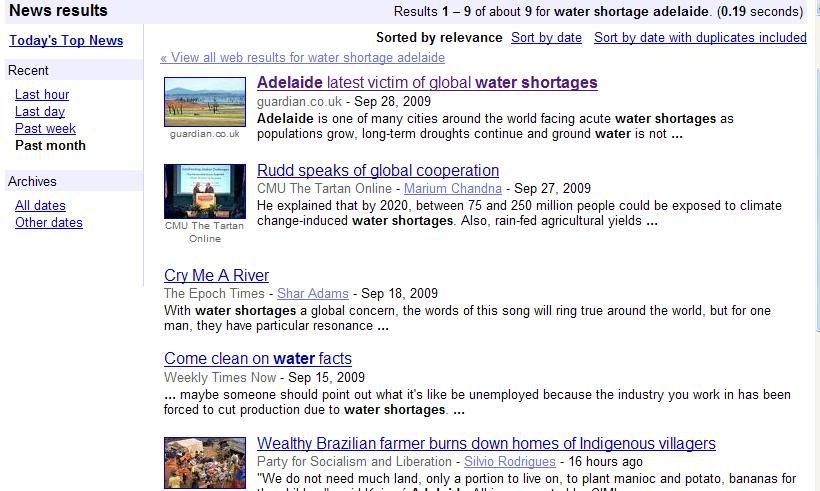


Oh.

9 potential news articles. Only one referring to this disaster, from the Gruaniad itself.

No bother, this means nothing. The Gruaniad journalists are quick off the mark. They get the scoops weeks before other inferior news hounds. A quick look at primary sources will reveal the astonishing speed with which these paragons of the news media have pounced on cold hard verifiable FACTS:
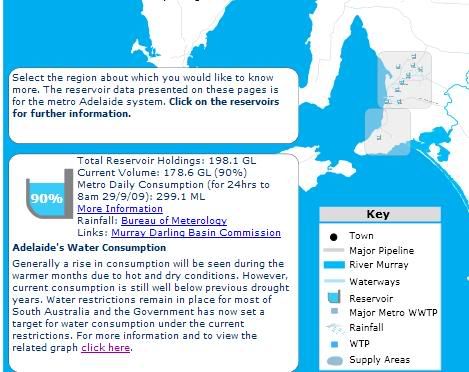


Oh.

Adelaide reservoirs 90% full. Maybe they are filling the bottles at the reservoirs for distribution to this thirsty city.

Never mind, the South Australian Water authority are consummate professionals. They will be on the case and will be ensuring that water is being used for the most essential purposes only. Sure enough, they have put everyone on LEVEL 3 ENHANCED WATER RESTRICTIONS!!! This is definitely serious.


Dripper systems and hand-held hoses fitted with a trigger nozzle can be used for a maximum of 3 hours a week
What? Don't these dolts realise that there will be NO WATER NEXT WEEK? And they are still letting people waste it on their gardens!?! They are rushing headlong into this disaster.

I await the upcoming Gruaniad reports of this unfolding crisis in the coming days with great anticipation.

UPDATE 14 OCTOBER:
I received this disturbing e-mail today [I do hope this poor soul survives]:

Still waiting on the bottled water to arrive. Can't hold out much
longer. So... thirsty...


Thursday, 24 September 2009

"Jobs"

Language is a powerful influence on the way we think. Take the word "jobs". An innocuous word in itself, used in many and varied context. Most people would be familiar with its use in forms such as:
"protecting jobs"
"creating jobs"
"exporting jobs"
"this will cost jobs"
"this government policy will cost jobs"
or my favourite at the moment:

"turning our back on Europe will cost jobs"
All leave a visual impression of a tangible object, like a book or a cup. Things that can indeed be "protected", "created" or moved from one place to another or even lost forever down the back of the sofa with all that loose change and lolly wrappers. The natural extension of such thinking is to believe implicitly that these things are fixed in number, that if I have it you can't. In economics speak, we would say rival in use, or consumption.

On those general impressions, reinforced by that language, the electorate in every country I can imagine believe they are involved in a global economic tug of war, fighting for these "jobs". This isn't good. For one, it provides the fuel for protectionist behaviour that adversely affects everyone's welfare.

The problem is, like many widely held beliefs about economics, this impression of "jobs" is wrong. It simply is not true that the relocation of output from one country to another (for example Dell moving from Ireland to Poland) will leave a hole created by a theft, or exportation, of "jobs". Nor is it true that some form of government policy (read public spending) is needed to fill such an imaginary hole.
And why is that the case? The reason is because there are no "jobs" per se, but an amount of labour that is needed to produce a given quantity of goods and services for the available technology and capital stock. And the amount of labour you use, relative to the amount of capital used (the level of known technology is simply a given at any point in time) will be determined by how much labour costs compared to capital.

If your production process requires you to open cans and labour is very expensive, you will buy an automated electric can opener and employ one person to operate it. If labour is cheap, you will buy 6 manual can openers and employ 6 people to operate them. The key is in the price of labour, or wages. "Jobs" will be there so long as wages are flexible and an economy is allowed to move from one state to another. They won't be lost, stolen, created, exported or anything else.

You can see the crux of the issue here though. It is all about the flexibility of wages; by which I mean the level of wages relative to everything else, including stuff in other countries. This is the only way that a shock to the economy, or any policy will "cost jobs" - if we refuse to allow wages to adjust.

So the only way that an economy is likely to be left with a shortage of "jobs" (i.e. persistent excessive unemployment) is if the price of labour doesn't adjust, or if some obstacle to movement of labour from one region to another, or from one industry or skill set to another is impeded. Note here that large scale government "training ", like the Irish FAS can in fact be such as impediment - but that is for another post.

What may happen is that wages might need to fall to restore full employment, which could imply a lower level of income on average. But there is no point in fighting that. It is a superior outcome to what would be a lower level of income and a larger number of unemployed people who are without employment for longer periods of time.

Here are the important implications of this that everyone should bear in mind:

A government does not, can not, "create jobs". Reject outright any rhetoric based on such a lie, it is usually a political ploy from the CEOs of the most dominant and powerful industry in the world, the political one.

Buying goods or services from abroad does not "cost jobs". Nor does buying domestic goods "support jobs".

Wednesday, 23 September 2009

When myth meets economics

Economists get a bad rap a lot of the time. And, on occasions it is well merited. But more often than is commonly imagined fault lies in alarming widespread and firmly held beliefs that support damaging policies by government.

Trade is a goldmine of examples. Take the experience of the Great Depression. One feature of the this tragic period in modern history was a descent into protectionism and an unwillingness to trade (i.e. import) goods and services from other countries. The graphic below is modestly famous, appearing in an Economist article on the Hawley-Smoot Tariff, that was arguably the catalyst to a general retreat into economic isolation around the world. Some think it ugly, or contrived, but I find the chart illustrates the annual contraction in the volume of trade. Each circle encompasses an amount of trade which gets smaller and smaller. Hawley-Smoot brought into effect more than 800 different tariff increases. Naturally, other countries followed suit. The result was less trade.

While supporters of these tariffs might try to maintain that the affect was as intended (keeping out foreign imports in favour of domestic production), they might baulk slightly when one explains that the chart below shows the decline in total world exports; most anti trade proponents tend to be of a mercantilist flavour and believe, no insist, that imports are bad while exports are good. Everyone was exporting less. This is of course a trick, every import is in fact an export, but the point is valid. There are no exports without imports. A type of Yang and Yin if you like.

What you don't see when you look at this chart is the loss in income and welfare around the world as we stopped trading with another.


That is an interesting trip down memory lane, but what relevance is it for today. Well there is more than one point to make.
  • Firstly, economists fight a never ending battle against the enemies of trade. Strangely, over time, this continues to be the overwhelming proportion of the population.
  • Secondly, trade protectionism is a classic knee-jerk response that comes at time of recession. It is intuitive, but badly flawed, to believe that you can "save jobs" by buying locally produced goods or services only or preferably.
  • Third, we are facing a rising specific threat at the moment. This is partly related to the point in the economic cycle in which we find ourselves, with unemployment high and rising nearly everywhere. But we also have to deal with Climate Change catastrophists who are lobbying and legislating for taxes on anything with a carbon-based energy component in it. Unfortunately, that is everything, because the use of energy has been the bed rock of our improving welfare ever since man lit his first fire and dramatically reduced mortality from hypothermia, nocturnal predictors and bacterial infection from eating raw meat. And given our present technology there is no cost comparable alternative.

One of the darrrrlings of the Climate Change Catastrophe industry is the Waxman-Markey Bill in the US which has plans to place an explicit or implicit tax on fossil fuel use. This would increase the cost of energy as a way of reducing its use. However, such a law introduced in the US would simply mean that production would move overseas. So the Bill has provision for tariffs to be applied to imports of goods from other countries. Bad news.

It doesn't end there, Nicolas Sarkozy is a fervent admirer of such an idea (what, an anti trade Frenchman???) as it could also help square the political circle for the EU thinking of doing something similar.

And people lap it up, keeping out those nasty imports.

I live in dread.

Tuesday, 22 September 2009

At last a "rock solid, steady" PC application

Is there some way we could convince these people to design a PC operating system?

The Conficker worm

"Conficker has proven to be the gold standard for botnets. It's rock solid,
it's steady
and it has mechanisms built in that have made it impossible for us to actually crack," Joffe said.

The next religious war

It is embarrassing to admit that this bloke is Australian. The stereotypical national character (perhaps self delusional) is of a skeptical, bordering cynical, nature. A person most likely to take a pause, look through the bullshit and call a spade a bloody spade; most usually to end in the appraisal of most situations with an assessment of "no worries".

I hope that strength of character isn't dead, because the country has bred the Flannery, a pale imitation of an Australian. A panicky scare monger who now foresees war, yes war, if countries don't toe his preferred line. That preferred line is a halt in the generation of income, goods and services as a way of stopping the production of a natural trace gas that is the very base of the food chain on this planet.

The only reason a war could come of this is over attitudes like Flannery's themselves. A self-fulfilling war arising out of demands by one group of people that everyone else adheres strictly to a set of punative and inequitable ideological principles and rules. Yes, we have been there before. This is just the threat of another religious war.

A note to Mr Flannery. I believe nothing good ever came from wilful subjugation. I will not bow to your destructive religious crusade and I doubt I am alone.

Thursday, 17 September 2009

Reap what you sow


Oxfam are now worried about the possible implications of diverting scarce resources from one problem to another.

Maybe they should have thought a little harder about their own actions when they started to spend their limited budget on political lobbying:

Photobucket


The reason I won't give to Oxfam. The road to hell is paved with good intentions and this mob are finding they might end up doing more harm than good.

Friday, 11 September 2009

Climate change madness

In the mad rush to avert that non-problem that is dangerous (man-made) climate change, we are told we need to pass laws, regulate and spend lots of taxpayers' money (glibbly taken by voracious government) to force the production of "renewable" energy sources. Stuff like wind, solar etc.

Of course the problem is the technology just isn't commercially viable yet. We would either have to pay a lot lot more for the power we use for transport, light and heat etc (especially nuclear, solar). or we would simply layer a another sum of capacity on top of fossil fuel (especially wind) because it won't be dependable enough to meet demand on it own.

If you dispute this, look at that paragon of sustainable energy, Denmark. After pouring a massive amount of taxpayers money into subsidised wind turbine production it finds it has to draw on foreign electricity production and charge the highest prices for electricity in Europe.

Compare Ireland - hardly a low cost electricity model. We pay more than twice as much as Americans and three times as much as Australians and Canadians. Consumers price is around 15 cents per kilowatt.

with Denmark, with its mass of windfarms consumers pay 24 cents per kilowatt.

I don't want to pay that. Irish electricity is too expensive as it is. But if individuals don't stand up to this madness that has captured the political agenda globally, that is what you face for no practical gain.