Thursday, 27 May 2010

Are markets missing the elephant in the room?

Greece is in dire fiscal straights, most would agree. A public budget and debt problem larger than they were willing to reveal to the world and now an inability to raise money to fund the growing debt pile and shortfall in government revenues with borrowings without an explicit guarrantee from fellow EU members.


The silly squabbling in Ireland is all about how we are in much better shape than Greece, or even Portgual or Spain. We have less government debt and are making "draconian" cuts in the public deficit.


If we have learnt anything from our recent economic history it should be to shun such ill judged hubris. We have proven to be a poor judge of our own policies or performance.


Let's have a more complete look at the problem.


First, nearly every measure of public indebtedness or annual borrowing I see is expressed as a percentage of GDP - a percentage of our national output. This is bad for Ireland. It should be expressed as a percentage of our National Income better appoximated by GNP or GNI. That increases all the figure by up to 25% (ie. 80% of GDP turns into 100% of GNP)


Secondly, we are being far too self congratulatory on fiscal initiatives to date. We have hardly made a scratch in the public sector imbalance between revenue and spending.


Third, while we have inadvisedly laughed at Greece hiding pile of government debt, Ireland has simply been doing the same in plain view. All the borrowing for NAMA related activities and bank recapitilisation is debt, but attempts are made to keep it "off balance sheet" without crudely hiding it.


But the final point is the big kicker. The problem isn't about public indebtedness, even though that is where all the focus has been. The problem is total indebtedness. How much debt in the public and private sector and consequently how much indebtedness to the rest of the world. It is pretty stupid to tihnk that an economy that has a reasonable large public debt stock and public deficit is in a more precarious state than one with slightly less debt and lower public deficit, but much more debt in the private sector.


When we borrow we are bringing forward future consumption. We then spend the subsequent years generating income to pay for the debt and pay it off. More debt (as a percentage of our income) means a large cut of our future income has to go to service and repay the debt. We also have reduced ability to serve our government debt obligations - which, let's face it, are just an extention of our collective private debt obligations as a nation.

That means reduced future standards of living. This trade-off is better for us if the we borrow to invest in assets that will reap income in the future (be that occupied housing, plant, infrastructure etc.). It is worse for us if we use it for final consumption (cars, furniture, holidays) or excessive investment (ghost estates etc.). Which of those sounds more like Ireland?


So to the data. The following shows the more comprehensive pciture of relative indebtedness across some European countries, including our fellow "PIGS". Now think about whether you would rather be exposed to Greek debt or Irish debt?


I wouldn't be so smug and probably wouldn't swap Greek bonds for Irish bonds, despite the contrary view that market is placing on the relative credit worthiness of the two countries at the moment.

Wednesday, 26 May 2010

Just how is that "climate change" investment getting on?

Remember, being told that the HSBC climate Change Index had been underperforming global equity returns because some beastly sceptics were hacking emails and other such nasty things like calling honest hard working grant farmer, I mean climate scientists horrid names?

And remember, that now we had most of those unsavoury events behind us, we could all glory and profit in the wonder that is the Green Economic Revolution(TM)? Yes? A do you remember me saying that you probably want to be a little bit more conerned about how the shareholders of such wonders as windfarms and solar panels and other economically destructive industries, companies and interest groups would manage to get the massive subsidies they need to produce any sort of return at all?

Well, it is certianly the case that the overriding investment theme this year is "we have bled taxpayers dry and will need to squeeze some more, so your stupid windfarms can live or die on their own". Well, the relative returns of the HSBC Climate Change Index this year look pretty much as you would expect under such circumstances.

Returns relative to global equities this year to 30 April -5.5%

http://www.morningstar.co.uk/UK/snapshot/snapshot.aspx?tab=0&id=F000000OC5&lang=en-GB

Crimes against the sales descriptions act

And today's is:

The "growth and stability pact"


One of the greatest problems with a common currency area is that it could leave constituent regions exposed to assymetric shocks. To the lay person that means, in effect, an even that pushes one or more countries into recession, but not others.

The "growth and stability pact" in general and the more recent "stability measures" announced by the European Commission force those countries mired in the worst recessions to impose the most pro-cyclical (recession exacerbating) fiscal policies.

How that enhances prospects for either growth or stability, I don't think I am clever enough to understand.

But. The big news is that we knew this a long long time ago...

....sigh...

Saturday, 1 May 2010

Get rich quick, the green way

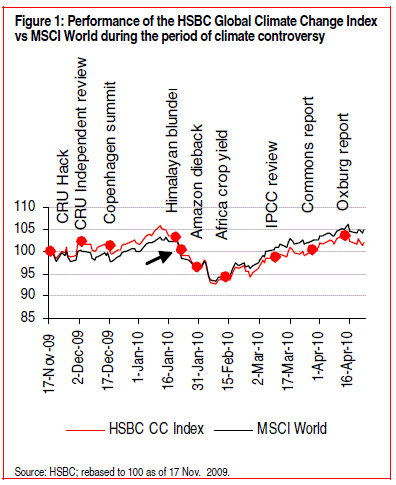
An interesting blog here at the FT on recent comparative returns from Climate Change related stocks relative to the general market. The general thesis is that businesses that operate in climate change related areas, like wind, solar or nuclear energy companies have produced lower relative returns to investors over a period during which the market has been slightly rattled by questions over the integrity of those producing the "science". They go on to say that everything will be hunky dory once the final whitewashes, sorry, I mean independent expert inquiries report and a full and completely clean bill of health is awarded to this shower of chancers and charlatons that call themselves a scientific discipline.

Here is the supporting chart with all the relevant dates and events as exhibit A.


Well, guess what. I think this is spurious anlaysis, that HSBC are producing this"research" to convince punters to buy into their index now and Kate Mackenzie at the FT has fallen for it hook line and sinker.

Here are the salient points this HSBC report fails to mention and Ms Mackenzie fails to spot. The majority of constituents of this index are companies who will only produce a return to shareholders if they get lots of taxpayers money. That i how the wind energy industry has got to where it is today. Taken from our pockets by politicians and placed into those who own and run these companies. People like Al Gore.

And what has been happening recently in Europe? Well, there has been a collective realisation that the finances of governments across Europe are in such a parlous state that bankruptcy is a very realistic possibility for places like Greece, Portugal, Italy, Spain and Ireland. Money for businesses that add no economic value like wind energy or solar energy companies just isn't there and investors awakening to the fact that the "Pig at the Taxpayer Filled Trough" business model has no immediate future until we get ourselves out of hock.

This is the type of event that was occurring in January, just at the time the HSBC CC Index started to hit trouble. Kate should have spotted a report on it. This one came from her newspaper:


There will be no bail-out of Greece by other European Union countries, a top European Central Bank official has said. “The markets are deluding themselves when they think at a certain point the other member states will put their hands on their wallets to save Greece,” Jürgen Stark, an executive board member, told Italian newspaper Il Sole 24 Ore.
Put that event on the chart above and it starts to take on a different meaning. In fact 7 January has a much better coincidence with the actual decline in relative performance than the "Himalayan Blunder" used on the chart, which clearly comes after the gap between the red and black lines closes.

Let's face it, markets really couldn't give a lambs whatsit for CRU whitewashes or an other irrelevant political shenanigans (they see through it as being completely political shenanigans).

And that is what the markets really think of this game - a pork barrel free for all. And that is why returns have been under-performing the wider equity market. And that is why would be mad to put money into these companies now.


Friday, 30 April 2010

Solidarity "bonds"? Thank you but no thanks

What a wheeze. The brains trust of the Irish government has launched a "National Solidarity Bond". Handing the cap around for our poor impoverished nation (hey buddy, can you spare a dime?).

Huzzaahhh. We're saved.


I wonder if they will get many takers? Let's pop the hood on this bad boy and check out what makes it go.

One problem right off the bat is that there is a blatant lie, right there in the name. This isn't a bond, it is a fixed term deposit. To make this a bond it would have to be a tradable security. It isn't tradable, so it isn't a bond.

Next, what do you get in return terms on this "National Solidarity Fixed Term Deposit"? A simple bit of financial arithmetic gives the answer as 4.1%. This comes from an annual 0.75% "coupon" after tax (a term we should on use for a real bond), plus an interest free bonus of 40% on maturity. You only get the bonus if you hang on for 10 years. If for some reason you need the money and have to withdraw, the maths is simple, you get a 0.75% after tax return. Is that a good return? Well, buy a real Irish Government bond today and you would get 5.2%. For the majority of the population that don't pay income tax it is a nice earner, if you think they are good for the money. Pay a top rate of tax and you would get around 2.9% per annum

Let's think a bit more about that 4% return though. So you get 4% annualised return, but all paid on maturity (your investment has a long "duration"). What might go wrong? Well, I mentioned that some misfortune might befall you, say after 9 years and you just have to take your money. Then you lose virtually your entire return.

Think also about interest rate risk. You are locked in to this return and if interest rates happened to go up significantly, say after five years, you would be sitting on a very poor return.

Think about inflation. 4.1% return is nominal. If inflation average 2% you get a 2.1% real return. But if it averaged 4% you would get a zero real return. It is easy now to think that inflation will always be low or non existent, but it is a dangerous animal. And the back end nature of your return, which cannot be sold on to anyone else (remember, this isn't a real bond), means that even if after a couple of years, you begin to get worried that inflation will rise, it is too late, you've lost.

So Buy real Irish Government bonds at 5.2%, or 2.9% after tax or a 10 year fixed term deposit with draconian early withdrawal penalties at 4.1% after tax? I think I would take the former, if I was stupid enough to lend anything to the Irish Government.

What puzzles me is why they didn't do something more sensible? How about a zero coupon government (real) bond issued at 34% discount to par (i.e buy for €66 and €100 is repaid in 10 years time). Capital gains on government bonds are not subject to tax for Irish residents, so there is your 4.1% return, but it is tradable. All they needed to do was arrange a deal with an Irish asset manager or life assurance company to package an investable fund for small investors. They could have even picked up the puny cost and fees involved (probably less than 0.1% per annum) allowing free entry and exit at a single price. Easy peasy. It is the same result for the Irish government - if they expect to fully repay interest and capital on everything they borrow.

And that is the catch (and why I lied). I do know why they went down the fixed deposit route. Think about it yourself. Why would you ask to borrow money from someone and promise to pay any material return only if they didn't ask for their money back before 10 years? In effect, allowing you to avoid paying any interest to anyone who, perhaps, started to worry in a few years whether you would repay anything?

You probably doubt your own creditworthiness.

But I just can't get passed the name. "National Solidarity Bonds". I just wouldn't enter into any bargain with someone who opens discussions with a lie.

Monday, 26 April 2010

Betting on the Euro

Another day another crisis for the Euro. Greek sovereign debt has now ballooned out to a 13% yield to maturity. Quite phenom anal, when you think back to the inception of the Euro and all sovereign risk premia were rapidly priced out of the market.

The dispersion on sovereign spreads is now quite dramatic. Ireland's are back to 2% (a country not massively dissimilar in fiscal characteristics to Greece). One way to interpret these developments is as a price on Euro break up.

If Greece never leaves the Euro, any holders of Greek debt will suffer Euro inflation risk only. With a 13% nominal annual return to maturity, I reckon that is a bet well worth having.

Secondly, if Greece never leaves the Euro it is difficult to see a debt default occurring. The most likely scenario in which the more fiscally sound members of the Eurozone allowed Greece to default would be one where fiscal problems were so widespread and large (say to Spain, Ireland and Italy) that a bailout of Greece would require an unaffordable bailout for all. And should that happen, it is surely almost certain that the Euro would break up, leaving Greece on the outside.

Considering those factors combined and if you agree with the logic, what you have here is a bet that Greece will still be a member of the Eurozone in 10 years time. Markets would appear to think this is increasingly likely that Greece could bring down the Euro.

So do you feel lucky, Punk?

Tuesday, 20 April 2010

Risk versus Uncertainty - in the skies over Europe

Planes are grounded yet again across Europe as volcanic ash and particulates disperse into the atmosphere out of Iceland. The "risk" to passenger safety is too great, so the authorities issue grounding orders across most of European airspace.

By all accounts the risks associated with flying an airplane into a cloud of volcanic emissions (catastrophic engine failure) are not worth the potential benefit (getting from A to B quickly). Hence, preventing planes from flying into such clouds is an extremely sensible risk mitigation policy. No argument. Then why are we starting to hear grumblings from airlines, complaining that they are being grounded unnecessarily?

Is it because they are just trying to turn a buck and there isn't much demand for a ticket on a plane that can't take off? Definitely.

Is it because airlines, driven by their profit motive, are more cavalier when it comes to risk? Almost certainly not.

So what gives?

It's all about risk versus uncertainty. So it is worth going back to basics to understand why these two animals are related, but different.
  • Risk is the extent to which any particular event may have multiple outcomes.
  • Uncertainty is the extent to which we have incomplete knowledge about the nature, range or relatively likelihood of these multiple outcomes.
For some people that is a "so what" proposition. However, I am pretty certain that for the overwhelming proportion of the population that is a "huh?" proposition. Assuming the former have already moved on, I will expand further for anyone interested in reading more.

Let's proceed by contrasting two examples. Let's first take a coin toss. Say we bet on a coin toss, so our fortunes are inextricably tied to the outcome. The toss exhibits "risk" for us, there are multiple potential outcomes - heads we win, tails we lose. However, there is relatively little "uncertainty" - a decent spinning toss should have a 50% chance of coming up heads and a 50% chance of coming up tails (rounded to exclude the odds of it landing on its edge). We can be pretty certain of those probabilities, if we know who is tossing the coin, how the coin is being tossed, the nature of the coin being tossed - these are all regular, observable (knowable) qualities. This example exhibits a lot of risk for us in our bet (one chance in two that we lose), but relatively little, if any, uncertainty (we are pretty confident that it is at least very close to a 50/50 chance)

Now lets look at flying in a plane. To simplify the infinite number of potential nuanced outcomes; the plane may complete its journey or the plane may crash. So, like the coin example, our next step is to try and quantify the relative likelihood of the potential outcomes (assuming we have correctly identified all relevant potential outcomes). In this situation the airlines and regulators have made decisions and taken actions that are designed to affect the relative likelihood of the outcomes (crash/not crash in our example). The plane has engines for example - always a good start. The pilots are trained professionals - always a bonus I find. There are copious check lists and scheduled maintenance routines. And so on and so forth. Moreover, we have emprical data for millions of commercial flights and only a very small proportion of those have resulted in crashes. So we are left with an estimate of the probabilities of Very Low (crash) versus Very High (not crash).

Where are the numbers, the hard probabilities this time I hear you ask. Well, I can't give them to you. Why? Because I am uncertain of all the various things that could possibly go wrong, be completely unanticipated, or are just so absurd as not to waste time considering them (shot down by an alien spacecraft). Such is uncertainty. In technical-speak, I am unable to specify the probability distribution function. In this example, we have low risk (the odds of crashing are estimated to be extremely low), but we have a lot of uncertainty (is the probability of a crash 0.01% or one hundred times greater at 1% for the specific flight in question? - we can't tell. It may in fact be 50% if someone happened to leave the work experience kid to do the pre flight engine check).

So what are the implications of this and how does this relate to plumes of volcanic ash?

Well, first off, note what is the most important implication of this understanding for risk and uncertainty. We act to mitigate against risk - that is try and prevent the known potential bad outcomes occurring. The more successful we are at doing that, removing risk, the more we are left with uncertainty. People who are scared to get on a plane because they are scared of the "risk", are actually scared of the "uncertainty" - the unknown or unknowable factors that might be at work. And you can't do anything about uncertainties directly - obviously because you don't know about them. And there is the crux:

Uncertainty is just a condition dependent on how much information we have - remember that because I will return to it.

So, on to the ash and trying to understand why airlines seem willing to fly their passengers into ash plumes, while regulators aren't. It isn't profit motive per se, although it must be accepted that the regulator isn't affect by whether the planes fly or not. In this particular instance there is specific cause to believe that a tussle between risk and uncertainty is taking place and one party might be confusing the two concepts.

According to reports, the Europe wide ban on flights is largely the result of the work of the UK Met Office. They model the atmosphere and predict where the volcanic emissions might drift. They come up with a result and recommend that flights be banned in the areas around which their model suggests the ash will be. Very sensible in itself, it is an attempt to assess the risk. However, what this work does not incorporate is physical measurements of where the ash actually is at any time. So, there is also significant uncertainty at work here.

Planes are being grounded because of the risk (the estimated odds), certainly. But, they are also being grounded because of the uncertainty (the not being confident of the estimated odds). Now, this is where things could possibly end. When we make such a decision, the uncertainty needs to be considered in conjunction with the risk and combined they suggest that it is prudent to ground planes.

So the airlines are wrong you might say. Well, not necessarily. What the airlines are validly pointing out is that the uncertainty part reflects our lack of sufficient information, which affects our confidence in assessing the risk. And they go on to point out that there is more information that could be obtained. That information is where is the ash in reality (as opposed to where it is modelled to be), which they suggest can be obtained by making measurements, possibly by flying suitable test flights in certain areas, or using balloon based sensors maybe. The simple analogy is that you don't put on a heavy coat when you leave home simply because you are uncertain about whether it is cold or not - you take whatever practical steps you can to gather a bit more information, like walk outside, so you can remove more of the uncertainty and leave yourself with the risk that it may or may not get cold later.

The airlines are saying that some of the uncertainty, which is part of the reason for the blanket flight ban, is not because we lack sufficient information, but because we aren't even bothering to gather the relevant information. And that is a valid point.

So who is right? Well, both are and neither are. We just don't know. We are dealing with uncertainty, remember? But one thing is certain. If we understand the difference between risk and uncertainty, we can make better decisions. In this case minimise the possibility of a crash, but also minimise the possibility that we are unnecessarily curtailing air transport.